IPTV buffering fix — Buffering means the player is not receiving or decoding data consistently enough. Test the same item with one controlled network or player change before resetting anything.
Buffering means the player is not receiving or decoding data consistently enough. Test the same item with one controlled network or player change before resetting anything.
IPTV buffering fix: what to know first
For IPTV buffering fix, separate the device, player, login method, home network, and source before changing settings. Start with the quick answer, then follow only the sections that match your setup. This keeps the troubleshooting path practical and makes it easier to explain the result if support is needed.
Define exactly when buffering or freezing happens
Start IPTV buffering fix troubleshooting by recording whether the symptom affects one item, one category, one device, one network, or everything. Scope often identifies the failing layer faster than changing settings.
On the intended playback device, start this check with Repeat the same authorised item from a clean player launch. Keep an authorised service and a compatible player unchanged while you test the section above, then compare the same item again. That isolates whether this layer actually changed the result instead of hiding the cause behind several simultaneous adjustments.
Check sustained network quality, Wi-Fi interference, and packet loss
The first technical pass should examine sustained network quality, Wi-Fi interference, and packet loss. Do not change credentials, player, network, and device at the same time or the result will not show which layer mattered.
On the intended playback device, start this check with Record the current setting before changing it. Keep an authorised service and a compatible player unchanged while you test the section above, then compare the same item again. That isolates whether this layer actually changed the result instead of hiding the cause behind several simultaneous adjustments.
Run a high-value comparison for IPTV buffering fix
Use Ethernet or a phone hotspot as the control where practical. A controlled comparison is more useful than repeated resets because it shows whether the symptom follows the account, player, device, or network.
On the intended playback device, start this check with Change one variable only. Keep an authorised service and a compatible player unchanged while you test the section above, then compare the same item again. That isolates whether this layer actually changed the result instead of hiding the cause behind several simultaneous adjustments.
Rule out local causes before destructive changes
Inspect free storage, player cache, decoder mode, and thermal load. Restarting or clearing a small cache can be useful, but factory reset or full data deletion should come after simpler evidence-based checks.
On the intended playback device, start this check with Check free storage and pending OS/app updates. Keep an authorised service and a compatible player unchanged while you test the section above, then compare the same item again. That isolates whether this layer actually changed the result instead of hiding the cause behind several simultaneous adjustments.
Escalate IPTV buffering fix with useful evidence
If local comparisons do not isolate the cause, send time, item, network path, player version, and interruption pattern. Mask usernames, passwords, tokens, playlist URLs, QR codes, and payment details.
On the intended playback device, start this check with Include the exact device and operating-system version. Keep an authorised service and a compatible player unchanged while you test the section above, then compare the same item again. That isolates whether this layer actually changed the result instead of hiding the cause behind several simultaneous adjustments.
Step-by-step checklist
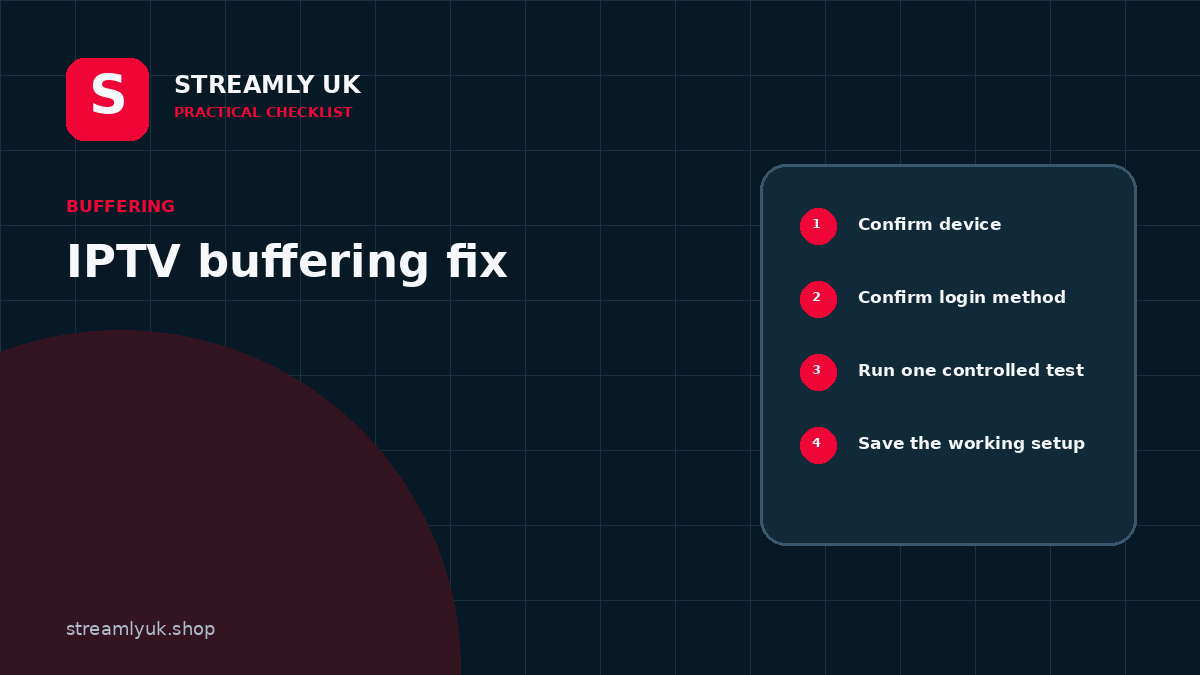
Follow the checklist in order. Skipping directly to destructive changes such as factory reset or clearing all app data can remove useful evidence and may create a second problem.
- 1Reproduce buffering or freezing on one known authorised item and record the exact time or error.
- 2Check sustained network quality, Wi-Fi interference, and packet loss.
- 3Run Ethernet or a phone hotspot while keeping the source and item unchanged.
- 4Inspect free storage, player cache, decoder mode, and thermal load.
- 5Restart the player and device once, then repeat the same test.
- 6Save logs or masked screenshots only after reproducing the symptom.
- 7Escalate with time, item, network path, player version, and interruption pattern if the issue persists.
Common problems and the next useful test
| Symptom | Likely area | Next test |
|---|---|---|
| Buffering or freezing affects one item | Item, source, codec, mapping, or track-specific behaviour | Compare two other known authorised items before changing the whole setup |
| Buffering or freezing affects one device | Player, device, storage, decoder, or local network | Run Ethernet or a phone hotspot while keeping the account and item unchanged |
| Buffering or freezing affects multiple devices | Account, service, credentials, or upstream network path | Check account status and escalate with time, item, network path, player version, and interruption pattern |
- Do not factory reset before reversible tests.
- A speed test measures a short transfer and does not reveal every packet-loss or jitter problem.
- Keep credentials out of public screenshots.
How to contact support without exposing credentials
Begin with the device model, operating-system version, player name and version, login method, exact error text, time of failure, and result of one controlled comparison. Mask server addresses, usernames, passwords, playlist tokens, QR codes, MAC-style identifiers, and payment details. A legitimate troubleshooting process should usually be able to narrow the problem before requesting a complete credential set.
When the issue is intermittent, keep a short log with the time, item tested, connection type, startup delay, and whether playback recovered. This is more useful than sending many screenshots without context. If access data has already been posted publicly, ask the provider to replace it rather than assuming deletion removed every copy.
What a successful result looks like
A useful result for IPTV buffering fix is not simply “it worked once.” The same authorised test should behave consistently on the intended playback device using an authorised service and a compatible player, with the expected picture, audio, captions or guide data, and without a new failure after a normal app restart. Save the working settings before experimenting further.
If the result is still inconsistent, stop changing multiple settings and return to the first symptom in the table above. The goal is to identify the narrowest failing layer—device, player, login, network, or source—so the next action is evidence-based and reversible.
Validation plan for the intended playback device
Before changing several settings, create a repeatable baseline for IPTV buffering fix. Use the intended playback device with an authorised service and a compatible player, keep the network path unchanged, and choose one authorised item that can be tested more than once. Record the start time, time to first picture, number and duration of interruptions, selected audio track, caption state, picture mode, and whether the guide data loads. This baseline turns a vague impression into evidence that can be compared after a change.
Run the first pass during the hours when the setup will normally be used. A test at a quiet time may miss congestion, Wi-Fi interference, or thermal behaviour that appears later. Restart the player and the device once, then repeat the same item without changing credentials. If the result differs after the restart, note that before trying another player or network.
First-pass evidence to save
Retest after one change
Change only one high-value variable: Wi-Fi to Ethernet, the current player to another maintained player, or the primary device to a known-good device. Repeat the same item and observation window. If the symptom disappears, return to the original setup once to confirm the difference. This A/B/A pattern is slower than random changes but produces a result that support can use.
Do not treat one successful start as proof that the setup is stable. Repeat the test after the device has been idle, after a fresh launch, and during a normal busy period. Save the working player and network configuration before experimenting further.
Ongoing maintenance checklist
Review the setup monthly and after a major app, operating-system, router, or account update. Confirm that the player still comes from the expected publisher, remove unused profiles, check free storage, review connected devices, and replace any credential that was exposed in a screenshot or shared chat. When a new problem appears, compare the date with recent changes before assuming the service itself has failed.
Keep the order confirmation, renewal date, player-licence receipt, and support contact separate from private access data. This makes renewal and support easier without spreading credentials across email, cloud notes, or family chats.
Frequently asked questions
What usually causes IPTV buffering fix?
The symptom can come from more than one layer. Start with sustained network quality, Wi-Fi interference, and packet loss, then use scope—one item, one device, one network, or everything—to decide which layer deserves the next test.
Should I reset the app immediately for IPTV buffering fix?
No. Reproduce the problem first, save the current configuration, and use reversible checks. A full data wipe or factory reset can remove useful evidence and create another setup problem.
What is the best comparison for IPTV buffering fix?
Where practical, use Ethernet or a phone hotspot. Keep the account, test item, and observation period unchanged so the result shows whether the symptom follows the changed layer.
What should I send support about IPTV buffering fix?
Send time, item, network path, player version, and interruption pattern. Also include the exact error text and one comparison result, while masking usernames, passwords, tokens, playlist URLs, QR codes, and payment details.
Sources and further reading
Official documentation and consumer resources are preferred because app availability, prices, device support, and service rules can change.