IPTV on LG TV — Start by identifying the exact LG Smart TV model and webOS version, then install a compatible player from LG Content Store. Test one authorised stream before importing a large library or changing several settings at once.
Start by identifying the exact LG Smart TV model and webOS version, then install a compatible player from LG Content Store. Test one authorised stream before importing a large library or changing several settings at once.
IPTV on LG TV: what to know first
For IPTV on LG TV, separate the device, player, login method, home network, and source before changing settings. Start with the quick answer, then follow only the sections that match your setup. This keeps the troubleshooting path practical and makes it easier to explain the result if support is needed.
Confirm the webOS version on LG Smart TV
LG Smart TV setup starts with the exact model and webOS version because app availability, decoding, storage, and update support can change by model year.
On LG Smart TV, start this check with Record the model number and operating-system version. Keep a webOS player that supports the supplied login method unchanged while you test the section above, then compare the same item again. That isolates whether this layer actually changed the result instead of hiding the cause behind several simultaneous adjustments.
Choose a player that fits LG Smart TV
LG webOS uses its own app ecosystem, so player availability and features can differ from Android TV, Fire TV, or mobile versions with similar names. Prefer a maintained app from the official store or a verified publisher, and test remote navigation before importing a large library.
On LG Smart TV, start this check with Verify the publisher and recent update history. Keep a webOS player that supports the supplied login method unchanged while you test the section above, then compare the same item again. That isolates whether this layer actually changed the result instead of hiding the cause behind several simultaneous adjustments.
Add one authorised profile on LG Smart TV
A small first profile is easier to diagnose than a full library. Enter credentials directly into the verified player and keep private URLs or tokens out of screenshots and public notes.
On LG Smart TV, start this check with Remove hidden spaces from copied server or playlist fields. Keep a webOS player that supports the supplied login method unchanged while you test the section above, then compare the same item again. That isolates whether this layer actually changed the result instead of hiding the cause behind several simultaneous adjustments.
Test playback, audio, and network behaviour on LG Smart TV
Check webOS storage, decoder behaviour, audio output, and app responsiveness before blaming the network or access credentials. Use the same authorised item for each comparison so changes in Wi-Fi, decoder, audio, or player settings can be evaluated separately.
On LG Smart TV, start this check with Measure the network at the television or streaming device during normal viewing hours. Keep a webOS player that supports the supplied login method unchanged while you test the section above, then compare the same item again. That isolates whether this layer actually changed the result instead of hiding the cause behind several simultaneous adjustments.
Keep a fallback path for LG Smart TV
If the webOS player is no longer maintained for the television model, an external streamer can provide a newer app ecosystem without replacing the display. Save the working player, profile, and network settings before experimenting with alternatives so recovery is quick after an app or OS update.
On LG Smart TV, start this check with Keep one second maintained player available for comparison. Keep a webOS player that supports the supplied login method unchanged while you test the section above, then compare the same item again. That isolates whether this layer actually changed the result instead of hiding the cause behind several simultaneous adjustments.
Step-by-step checklist
Follow the checklist in order. Skipping directly to destructive changes such as factory reset or clearing all app data can remove useful evidence and may create a second problem.
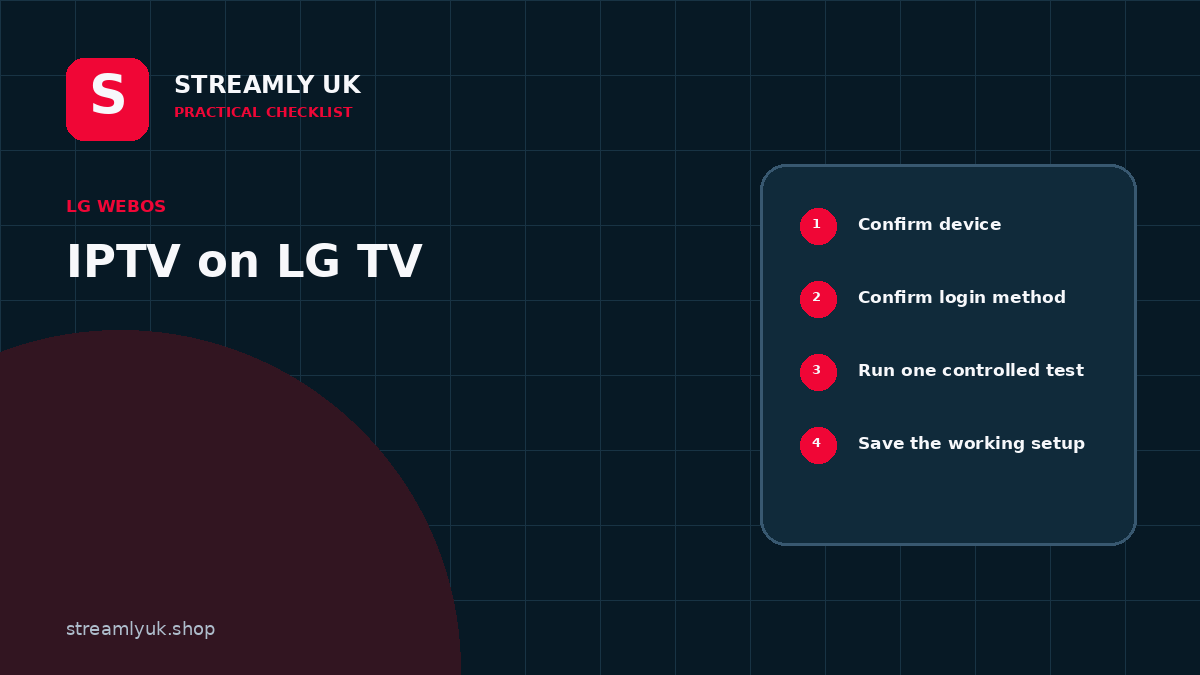
- 1Record the exact LG Smart TV model and webOS version.
- 2Open LG Content Store and install a maintained compatible player from the expected publisher.
- 3Confirm whether the authorised access method is M3U, Xtream-style login, HLS, or another supported format.
- 4Add one small test profile without exposing the complete playlist URL or password.
- 5Play the same authorised item for several minutes and check picture, audio, captions, and EPG behaviour.
- 6Compare Wi-Fi with Ethernet or another known-good network if playback is unstable.
- 7Save the working configuration and only then import the larger library or customize the player.
Common problems and the next useful test
| Symptom | Likely area | Next test |
|---|---|---|
| App is missing or incompatible | webOS version, region, or store support | Check LG Content Store, model support, and the publisher compatibility list |
| List loads but playback fails | Codec, decoder, player engine, or source format | Test the same item in a second maintained compatible player |
| Playback is unstable | Wi-Fi, storage, thermal load, or background activity | Compare a known-good network and check free storage before resetting the app |
- LG Content Store varies by region and webOS generation.
- Large libraries and guide data can stress storage on older televisions.
- A player licence is separate from the streaming service.
How to contact support without exposing credentials
Begin with the device model, operating-system version, player name and version, login method, exact error text, time of failure, and result of one controlled comparison. Mask server addresses, usernames, passwords, playlist tokens, QR codes, MAC-style identifiers, and payment details. A legitimate troubleshooting process should usually be able to narrow the problem before requesting a complete credential set.
When the issue is intermittent, keep a short log with the time, item tested, connection type, startup delay, and whether playback recovered. This is more useful than sending many screenshots without context. If access data has already been posted publicly, ask the provider to replace it rather than assuming deletion removed every copy.
What a successful result looks like
A useful result for IPTV on LG TV is not simply “it worked once.” The same authorised test should behave consistently on LG Smart TV using a webOS player that supports the supplied login method, with the expected picture, audio, captions or guide data, and without a new failure after a normal app restart. Save the working settings before experimenting further.
If the result is still inconsistent, stop changing multiple settings and return to the first symptom in the table above. The goal is to identify the narrowest failing layer—device, player, login, network, or source—so the next action is evidence-based and reversible.
Validation plan for LG Smart TV
Before changing several settings, create a repeatable baseline for IPTV on LG TV. Use LG Smart TV with a webOS player that supports the supplied login method, keep the network path unchanged, and choose one authorised item that can be tested more than once. Record the start time, time to first picture, number and duration of interruptions, selected audio track, caption state, picture mode, and whether the guide data loads. This baseline turns a vague impression into evidence that can be compared after a change.
Run the first pass during the hours when the setup will normally be used. A test at a quiet time may miss congestion, Wi-Fi interference, or thermal behaviour that appears later. Restart the player and the device once, then repeat the same item without changing credentials. If the result differs after the restart, note that before trying another player or network.
First-pass evidence to save
Retest after one change
Change only one high-value variable: Wi-Fi to Ethernet, the current player to another maintained player, or the primary device to a known-good device. Repeat the same item and observation window. If the symptom disappears, return to the original setup once to confirm the difference. This A/B/A pattern is slower than random changes but produces a result that support can use.
Do not treat one successful start as proof that the setup is stable. Repeat the test after the device has been idle, after a fresh launch, and during a normal busy period. Save the working player and network configuration before experimenting further.
Ongoing maintenance checklist
Review the setup monthly and after a major app, operating-system, router, or account update. Confirm that the player still comes from the expected publisher, remove unused profiles, check free storage, review connected devices, and replace any credential that was exposed in a screenshot or shared chat. When a new problem appears, compare the date with recent changes before assuming the service itself has failed.
Keep the order confirmation, renewal date, player-licence receipt, and support contact separate from private access data. This makes renewal and support easier without spreading credentials across email, cloud notes, or family chats.
Frequently asked questions
What is the safest way to install an IPTV player on LG webOS?
Use LG Content Store, verify the developer, and avoid unofficial APK or profile downloads unless the publisher provides a verifiable distribution path.
Why does the playlist load but video stay black?
Playlist import and video decoding are separate stages. The app may understand the list while the device or selected playback engine cannot decode the specific video or audio format.
Should I reset the device first?
No. Start with a restart, free-storage check, app update, network comparison, and second-player test. A factory reset removes useful evidence and creates extra work.
Can I share my full login with support?
Not in a public message. Begin with the device, app, login method, error text, and test results. Share secrets only through a verified private channel when necessary.
Sources and further reading
Official documentation and consumer resources are preferred because app availability, prices, device support, and service rules can change.